Developing
Monday, October 04, 2021


Tuesday, December 09, 2014
Does anyone read blog posts anymore?
Debating starting this back up again.
Anyone still reading these?
Anyone still reading these?
Thursday, March 27, 2014
Changes
MAINTENANCE NOTICE - - -
I'm experimenting with some automation, so the content of this blog may change in the next few days...stay tuned . . .
I'm keeping the old content on this site, but I'm leaning to a blog that automatically posts viral content on a regular basis. If this is successful, I will likely move the "viral" content to a new Blogger account.
I'm experimenting with some automation, so the content of this blog may change in the next few days...stay tuned . . .
I'm keeping the old content on this site, but I'm leaning to a blog that automatically posts viral content on a regular basis. If this is successful, I will likely move the "viral" content to a new Blogger account.
Sunday, July 24, 2011
How Foursquare Could Be Better And Why I Am Done With It (For Now)
I'm a gadget guy. I love to try out new technologies, web services and geek toys. Usually I fiddle with a "new amazing thing-a-ma-jig" until I find a purpose for it in my life or I it becomes laborious so I delete/stop using it. Foursquare is an example of one such thing-a-ma-jig that I have been playing with and I've decided to delete.
The concept is simple enough with the web service Foursquare:
Wikipedia defines it as: "...a location-based social networking website based on hardware for mobile devices. The service is available to users with GPS-enabled mobile devices such as smart phones. Users 'check-in' at venues using a mobile website, text messaging or a device-specific application by running the application and selecting from a list of venues that the application locates nearby. Each check-in awards the user points and sometimes 'badges'."
For those of you who have never heard of it and are reading about it here you are probably asking WHY in the world would anyone want to do this? What's in it for them? This is my question exactly.
A little backstory: I've been using Foursquare off and on for the last two years. I make an effort to "check-in" often and from time to time will add a picture or comment. To date I have received no return on the investment of time and energy I have put into "checking in". Yes, it DOES take time and energy to "check in". You have to pull out your smart phone, navigate to the correct application, find the appropriate location to "check in" and then comment about your activities (this last step is optional.) That's a lot of steps to get nothing in return.
Yes, I am aware that there are "Mayorship" deals and first time check-in awards for certain locations, but this really doesn't influence where I go (nor where I check-in.) I am finding I'm doing most of my checking-in out of obsessive habit. Walking through a parking lot with my eyes glued to an iPhone isn't probably the best use of time either.
Admittedly, the social aspect is nice, but not really anything that Twitter or Facebook isn't already doing (you can geotag your tweets and on Facebook you can check in using the "Places" feature.) Once in a blue moon I will have a friend mention that they noticed that I have checked into some place interesting...but that was back when I had my checkins going to Facebook and Twitter automatically (I've since turned them both off because no one cares if I become mayor of a dog park or a historic prison...which I am by the way.)
So here I am providing someone with all sorts of data about my shopping habits yet I really don't see what I am getting from it. I'm sure that a market researcher finds it interesting that I am at place "X" at "Y" time of day every "Z" day of the week. It seems to me that this "data" could be used to help market things that may be interesting to me. Simply put, I know my checkins are worth something.
This is why I'm done with Foursquare for now. Until they either monetize my checkins or start rewarding me with incentives* that are impacting to my pocketbook, I have to stop using it.
*It took me 10 days to become mayor of my neighborhood Goodwill only to find out that I get a 10% discount...in the end it didn't feel worth the effort.
MY IDEA(S) FOR IMPROVING FOURSQUARE
Let's move away from having to actively check in. At the most users should be checked in automatically or at the very least confirm the locations where they are or have been (meaning at the end of the day you could retroactively check in to the various places you had been during the day. No, this isn't very useful from a "real-time" status point of view, but that data is still useful.)
Here's the "key"...pun intended: I personally think Foursquare should develop a Foursquare electronic key fob. This electronic device would go on your keychain and would check you in automatically to locations that support this device. The fob would have a small display (LCD) that gives the business name you where you are about to check in to. You would have the ability to scroll through nearby business and confirm your location if the default location was incorrect. One important feature of the fob would be the ability to turn it off easily (in case you do NOT want a passive check-in to occur.)
In order for this to work, the store (or location) would need to provide the short range network (wifi, RFID, infrared, etc.) Obviously we couldn't have something on our keychains that utilized a phone network nor would it make sense for a GPS sensor to be placed in a fob. This short range network would be provided by the folks at Foursquare. All a vendor would need to do is plug it in and hook it up to a phone line or network connection.
If the right partnerships were created with stores and Foursquare, I don't see why we (the users) couldn't reap the benefits of sharing our whereabouts (i.e. market data.) A fob owner could receive a monthly incentives or coupons from Foursquare based on their checkins. These coupons could include places the user may have not been yet but are similar to my venue tastes.
The question you may have is "where would the money come from?" Foursquare would provide the boxes that a store would have to provide the short range network and it would cost the business a certain amount of money per month (a sliding scale would make the most sense based on business size.) The data that these boxes collected would be compiled at Foursquare and then sold back to businesses too. Maybe if you're a small clothing venue, you would pay Foursquare a small fee to find out the demographics, habits and the number of competing small clothing venue checkins in the area. A larger business with deeper pockets would get monthly (or weekly or daily) reports with deeper analysis of the data and (for a fee) provide compelling sales pieces about their customers, etc etc etc.
Big picture, Foursquare has the ability to become a huge data repository to help businesses grow while maintaining an entertaining social media network.
Maybe Foursquare has been down this road and they are working on something similar. For now, I'm removing it from my phone and we'll see if it negatively impacts my life. I'm guessing not.
The concept is simple enough with the web service Foursquare:
Wikipedia defines it as: "...a location-based social networking website based on hardware for mobile devices. The service is available to users with GPS-enabled mobile devices such as smart phones. Users 'check-in' at venues using a mobile website, text messaging or a device-specific application by running the application and selecting from a list of venues that the application locates nearby. Each check-in awards the user points and sometimes 'badges'."
For those of you who have never heard of it and are reading about it here you are probably asking WHY in the world would anyone want to do this? What's in it for them? This is my question exactly.
A little backstory: I've been using Foursquare off and on for the last two years. I make an effort to "check-in" often and from time to time will add a picture or comment. To date I have received no return on the investment of time and energy I have put into "checking in". Yes, it DOES take time and energy to "check in". You have to pull out your smart phone, navigate to the correct application, find the appropriate location to "check in" and then comment about your activities (this last step is optional.) That's a lot of steps to get nothing in return.
Yes, I am aware that there are "Mayorship" deals and first time check-in awards for certain locations, but this really doesn't influence where I go (nor where I check-in.) I am finding I'm doing most of my checking-in out of obsessive habit. Walking through a parking lot with my eyes glued to an iPhone isn't probably the best use of time either.
Admittedly, the social aspect is nice, but not really anything that Twitter or Facebook isn't already doing (you can geotag your tweets and on Facebook you can check in using the "Places" feature.) Once in a blue moon I will have a friend mention that they noticed that I have checked into some place interesting...but that was back when I had my checkins going to Facebook and Twitter automatically (I've since turned them both off because no one cares if I become mayor of a dog park or a historic prison...which I am by the way.)
So here I am providing someone with all sorts of data about my shopping habits yet I really don't see what I am getting from it. I'm sure that a market researcher finds it interesting that I am at place "X" at "Y" time of day every "Z" day of the week. It seems to me that this "data" could be used to help market things that may be interesting to me. Simply put, I know my checkins are worth something.
This is why I'm done with Foursquare for now. Until they either monetize my checkins or start rewarding me with incentives* that are impacting to my pocketbook, I have to stop using it.
*It took me 10 days to become mayor of my neighborhood Goodwill only to find out that I get a 10% discount...in the end it didn't feel worth the effort.
MY IDEA(S) FOR IMPROVING FOURSQUARE
Let's move away from having to actively check in. At the most users should be checked in automatically or at the very least confirm the locations where they are or have been (meaning at the end of the day you could retroactively check in to the various places you had been during the day. No, this isn't very useful from a "real-time" status point of view, but that data is still useful.)
Here's the "key"...pun intended: I personally think Foursquare should develop a Foursquare electronic key fob. This electronic device would go on your keychain and would check you in automatically to locations that support this device. The fob would have a small display (LCD) that gives the business name you where you are about to check in to. You would have the ability to scroll through nearby business and confirm your location if the default location was incorrect. One important feature of the fob would be the ability to turn it off easily (in case you do NOT want a passive check-in to occur.)
In order for this to work, the store (or location) would need to provide the short range network (wifi, RFID, infrared, etc.) Obviously we couldn't have something on our keychains that utilized a phone network nor would it make sense for a GPS sensor to be placed in a fob. This short range network would be provided by the folks at Foursquare. All a vendor would need to do is plug it in and hook it up to a phone line or network connection.
If the right partnerships were created with stores and Foursquare, I don't see why we (the users) couldn't reap the benefits of sharing our whereabouts (i.e. market data.) A fob owner could receive a monthly incentives or coupons from Foursquare based on their checkins. These coupons could include places the user may have not been yet but are similar to my venue tastes.
The question you may have is "where would the money come from?" Foursquare would provide the boxes that a store would have to provide the short range network and it would cost the business a certain amount of money per month (a sliding scale would make the most sense based on business size.) The data that these boxes collected would be compiled at Foursquare and then sold back to businesses too. Maybe if you're a small clothing venue, you would pay Foursquare a small fee to find out the demographics, habits and the number of competing small clothing venue checkins in the area. A larger business with deeper pockets would get monthly (or weekly or daily) reports with deeper analysis of the data and (for a fee) provide compelling sales pieces about their customers, etc etc etc.
Big picture, Foursquare has the ability to become a huge data repository to help businesses grow while maintaining an entertaining social media network.
Maybe Foursquare has been down this road and they are working on something similar. For now, I'm removing it from my phone and we'll see if it negatively impacts my life. I'm guessing not.
Friday, October 16, 2009
It Could Happen To You . . .
Date: October 15th, 2009
Time: 5:55 PM to 8:15 PM
Location: Northwest Washington D.C.
5:55 PM - Typically on Thursday nights Nicole volunteers in Northwest D.C. and I come with her and linger at a bookstore nearby. On this night I walked Nicole to the door of the non-profit organization then walked a quarter mile back to the bookstore.
6:00 PM - Arrived at bookstore (which has a cafe).
6:02 PM - Picked up an in-store copy of "Horse Soldiers" (Nicole had the excellent idea of instead of bringing my own book, to just remember the page I am on and use the book at the store).
6:04 PM - Ordered a mocha.
6:05 PM - Barista asks if I want whipped cream. I respond with yes.
6:05:10 PM - Barista asks if I want chocolate drizzled on top. I respond with yes.
6:06 PM - I have mocha in hand (the whipped cream and chocolate rise above the rim at least an inch or two).
6:07 PM - I sit in the public area with chairs and couches. I make a mental note that it's a full house (only one chair is available...front and center of the cafe).
6:09 PM - I open up the book to the last pages of the last chapter--I'm excited to finish.
6:10 PM - I drink (and almost guzzle) my delicious mocha.
6:12 PM - Mocha is finished...so good!
6:13 PM - Return to reading my book.
6:20 PM - People filter in and out of the coffee shop. I look up and make eye contact with a man in his 70's. He looks at me like he knows me. I smile and return to my book.
6:30 PM - Get an alert on my phone that some kid who was thought to be in a balloon over Colorado has been found safe.
6:31 PM - Continue reading.
6:44 PM - A teenager sits to my immediate right at a table facing me.
6:47 PM - Same teenager starts texting on her phone. I look over and she looks down to her phone suddenly.
6:48 PM - Continue reading.
6:55 PM - A woman walks by and looks at me as if I'm familiar to her. I smile politely...she does not return the smile.
7:05 PM - I read through the epilogue of the book.
7:07 PM - Teenager next to me is STILL texting and looking at me. I think to myself, do I look like someone famous?
7:08 PM - I look across the room and the woman who walked by is looking at me but then quickly looks down at her work.
7:18 PM - I finish Horse Soldiers.
7:19 PM - I log onto Twitter to write a very brief review of the book.
7:22 PM - My friend from UC Irvine starts chatting with me on my iphone (instant messaging).
7:33 PM - An awkward man sits at the table across from me. He wears his pants really high and is wearing white socks with black loafers. He looks at me, smiles, then sits down.
7:45 PM - Still chatting with friend online. Look up to see that awkward man is staring at me.
7:55 PM - A college study group shows up. Many of them look in my general direction. I feel like I am sitting in a seat reserved for someone else as they look at me and talk amongst themselves.
7:56 PM - Teenager still texting next to me...avoiding eye contact when I look that direction.
8:01 PM - Nicole sends me a text to let me know that she is done volunteering.
8:01:01 PM - I send her a text that I am on my way to her location.
8:04 PM - I walk down the stairs of the bookstore and a very official man is going up the escalator. He looks at me for a very long time. I smile nervously and continue down the stairs.
8:08 PM - I can see Nicole in the darkness two blocks ahead of me walking in my direction.
8:09 PM - I meet up with her and prepare to give her a kiss.
8:10 PM - Nicole stops me and says "WHAT IS ALL OVER YOUR NOSE? IS THAT CHOCOLATE AND WHIP CREAM?" (See 6:10 PM entry)
8:10:01 PM - A wave of embarrassment sweeps over my body. I touch my nose to feel the softness of cream and the stickiness of dark chocolate all over the tip of my nose. My mind flashes back (much like the ending of "The Usual Suspects"). All of those people staring at me for the last two hours said NOTHING. Here I felt like maybe I looked like someone they knew, or that I had taken a "regular's" seat. How hard would it have been for someone to politely come up to me and say "Sir, there is chocolate and whip cream on your nose." Someone could have gestured towards their nose and I probably would have taken the hint.
8:10:30 PM - I say to Nicole "That's why everyone was staring at me!"
8:10:31 PM - Nicole collapses in laughter.
8:10:45 PM - I explain to her the sequence of events. Nicole laughs even harder!
8:11 PM - I wipe my nose again to make sure that I got every ounce of it off.
8:12 PM - We make our way to the Metro.
8:14 PM - I do a search on Twitter to see if anyone posted anything about a "Bald Guy sitting in bookstore with whip cream and chocolate on his nose--oblivious.")
8:15 PM - The search reveals that no one posted it so in good humor I post it about myself.
Time: 5:55 PM to 8:15 PM
Location: Northwest Washington D.C.
5:55 PM - Typically on Thursday nights Nicole volunteers in Northwest D.C. and I come with her and linger at a bookstore nearby. On this night I walked Nicole to the door of the non-profit organization then walked a quarter mile back to the bookstore.
6:00 PM - Arrived at bookstore (which has a cafe).
6:02 PM - Picked up an in-store copy of "Horse Soldiers" (Nicole had the excellent idea of instead of bringing my own book, to just remember the page I am on and use the book at the store).
6:04 PM - Ordered a mocha.
6:05 PM - Barista asks if I want whipped cream. I respond with yes.
6:05:10 PM - Barista asks if I want chocolate drizzled on top. I respond with yes.
6:06 PM - I have mocha in hand (the whipped cream and chocolate rise above the rim at least an inch or two).
6:07 PM - I sit in the public area with chairs and couches. I make a mental note that it's a full house (only one chair is available...front and center of the cafe).
6:09 PM - I open up the book to the last pages of the last chapter--I'm excited to finish.
6:10 PM - I drink (and almost guzzle) my delicious mocha.
6:12 PM - Mocha is finished...so good!
6:13 PM - Return to reading my book.
6:20 PM - People filter in and out of the coffee shop. I look up and make eye contact with a man in his 70's. He looks at me like he knows me. I smile and return to my book.
6:30 PM - Get an alert on my phone that some kid who was thought to be in a balloon over Colorado has been found safe.
6:31 PM - Continue reading.
6:44 PM - A teenager sits to my immediate right at a table facing me.
6:47 PM - Same teenager starts texting on her phone. I look over and she looks down to her phone suddenly.
6:48 PM - Continue reading.
6:55 PM - A woman walks by and looks at me as if I'm familiar to her. I smile politely...she does not return the smile.
7:05 PM - I read through the epilogue of the book.
7:07 PM - Teenager next to me is STILL texting and looking at me. I think to myself, do I look like someone famous?
7:08 PM - I look across the room and the woman who walked by is looking at me but then quickly looks down at her work.
7:18 PM - I finish Horse Soldiers.
7:19 PM - I log onto Twitter to write a very brief review of the book.
7:22 PM - My friend from UC Irvine starts chatting with me on my iphone (instant messaging).
7:33 PM - An awkward man sits at the table across from me. He wears his pants really high and is wearing white socks with black loafers. He looks at me, smiles, then sits down.
7:45 PM - Still chatting with friend online. Look up to see that awkward man is staring at me.
7:55 PM - A college study group shows up. Many of them look in my general direction. I feel like I am sitting in a seat reserved for someone else as they look at me and talk amongst themselves.
7:56 PM - Teenager still texting next to me...avoiding eye contact when I look that direction.
8:01 PM - Nicole sends me a text to let me know that she is done volunteering.
8:01:01 PM - I send her a text that I am on my way to her location.
8:04 PM - I walk down the stairs of the bookstore and a very official man is going up the escalator. He looks at me for a very long time. I smile nervously and continue down the stairs.
8:08 PM - I can see Nicole in the darkness two blocks ahead of me walking in my direction.
8:09 PM - I meet up with her and prepare to give her a kiss.
8:10 PM - Nicole stops me and says "WHAT IS ALL OVER YOUR NOSE? IS THAT CHOCOLATE AND WHIP CREAM?" (See 6:10 PM entry)
8:10:01 PM - A wave of embarrassment sweeps over my body. I touch my nose to feel the softness of cream and the stickiness of dark chocolate all over the tip of my nose. My mind flashes back (much like the ending of "The Usual Suspects"). All of those people staring at me for the last two hours said NOTHING. Here I felt like maybe I looked like someone they knew, or that I had taken a "regular's" seat. How hard would it have been for someone to politely come up to me and say "Sir, there is chocolate and whip cream on your nose." Someone could have gestured towards their nose and I probably would have taken the hint.
8:10:30 PM - I say to Nicole "That's why everyone was staring at me!"
8:10:31 PM - Nicole collapses in laughter.
8:10:45 PM - I explain to her the sequence of events. Nicole laughs even harder!
8:11 PM - I wipe my nose again to make sure that I got every ounce of it off.
8:12 PM - We make our way to the Metro.
8:14 PM - I do a search on Twitter to see if anyone posted anything about a "Bald Guy sitting in bookstore with whip cream and chocolate on his nose--oblivious.")
8:15 PM - The search reveals that no one posted it so in good humor I post it about myself.
Sunday, September 13, 2009
Back To Basics
 I've painted myself into a corner.
Somewhere around January I took this whole thing off track. I was so fascinated by the sociological implications of Facebook, Twitter, iPhones, and the countless other digital distractions that I thought I could do a commentary on them. I don't know why I thought I could be an authority when I didn't really do much other than read about them. Learning about them is really just a Google Search away.
Ironically the iPhone entered my life at the end of June and Twitter became very useful shortly after that (thanks to Tweetie.) In mid-July I took a week to analyze Facebook and hunt for old Marine Corps friends (with little success.) Alas, it was a great experience, but in the end I realized there is absolutely nothing wrong with Facebook...it's just not right for me.
 I'm not sure why I wanted to write a long essay on the risks and rewards of these variable digital distractions. At this moment I realize that it's not the devices or websites that can be a problem, but the way people use them.
For those of you who have been waiting for this Facebook, Twitter, iPhone mega post...it's not going to happen. I'm not the expert. I love to talk to people in person on how I "feel" about social media, but I don't feel comfortable making blanket statements here. Lastly, I want the content of this blog to be unique and I'm okay with it not following any rhyme or reason.
* * *
So it has been nine months since I have written about the real world things going on in my life. I can tell that my writing is rusty and I need to write more even about the seemingly small stuff.
 We moved to Washington D.C. in June in pursuit of "Better Living" and we are really happy to be here. The Northwest will always be where our hearts are, but we needed to move to an area that provided an "education" that we could take back with us. Most conversations that we get into with others (from new friends to strangers on the Metro) lead to learning something new. Since we've been out here, Nicole and I have been inspired in many directions that otherwise wouldn't have happened had we stayed in the Northwest. We're calling this chapter of our lives "The D.C. Internship."
 Just yesterday we took the Metro to D.C. for Vegfest. While Nicole was volunteering at a booth there, I went searching for protesters that were marching to the Capitol. On my walk, I found a group of people playing roller hockey behind the White House. When I say behind, I mean literally behind...on the pedestrian-only street that runs behind it. It was a little surreal.
Meanwhile, there was a protest somewhere, but I must have missed it. I walked to Freedom Square only to find trash blowing in the wind and a handful of city workers cleaning up. It was really weird because I could almost feel the warmth of the thousands of people still on the bricks yet it was quiet (by then they must have reached the Capitol.)
 Following my failed photo shoot I returned to Nicole only to hop on a shuttle bus to the Kennedy Center for an open house. We arrived to find clusters of people surrounding various street performers from all over the world. They were performing on various stages around the building. One thing about Washington D.C. is that there seems to be plenty of high quality free entertainment. This was no exception. I enjoyed watching the kids laugh and smile even more than I enjoyed watching the various performances of jugglers, unicyclists, and pantomime performances. A street performer can really grab the attention of a child (and an adult's "inner child".)
We left the Kennedy Center and headed to our favorite downtown theater, the Landmark E-Street Theater. Located just a few blocks away from the White House, it is a great theater for seeing foreign, documentary, and independently produced films. So far we have seen "Food Inc." (3 times), "In The Loop", and yesterday "It Might Get Loud". This last movie was great if you love guitar and Jack White-The Edge-Jimmy Page.
We returned to our place greeted by our full-bladder dog who was very happy to see us.
I hope to write more often on a daily basis. I will write about technology, simplicity, and perhaps the incredible things that happen to us while we're out here.
Monday, August 31, 2009
Welcome Twitter Users
So I'm still working on my Twitter/Facebook Manifesto (hopefully I am able to finish it!)
In the meantime, take this poll and I will add it to the story (if enough people respond.)
My various Twitter accounts:
http://twitter.com/annieisadog Life through the eyes of our dog
http://twitter.com/thetweetlab My primary Twitter account...I do a lot of testing using this account
http://twitter.com/nicoleandjeff More of our joint Twitter account...good for status updates regarding us in a general sense
http://twitter.com/breakinginfo This is a strictly news account. I mostly monitor the news here, but will occasionally retweet (or even break my own news)
http://twitter.com/idwhatiam This one is just for fun...I have a camera on my cell phone so I take pictures of things (bugs, birds, strange objects) and try to get people to guess what they are.
In the meantime, take this poll and I will add it to the story (if enough people respond.)

My various Twitter accounts:
http://twitter.com/annieisadog Life through the eyes of our dog
http://twitter.com/thetweetlab My primary Twitter account...I do a lot of testing using this account
http://twitter.com/nicoleandjeff More of our joint Twitter account...good for status updates regarding us in a general sense
http://twitter.com/breakinginfo This is a strictly news account. I mostly monitor the news here, but will occasionally retweet (or even break my own news)
http://twitter.com/idwhatiam This one is just for fun...I have a camera on my cell phone so I take pictures of things (bugs, birds, strange objects) and try to get people to guess what they are.
Tuesday, August 11, 2009
Coming Soon
I've received numerous email and calls asking for updates. Since moving from the Northwest to a yet to be disclosed location, I have been busy testing Facebook, Twitter, an iPhone, and a pair of really interesting shoes.
 I will do my best to follow through with a promised entry in the next week or so. In the meantime, here are some links that are a great prologue to the post that I'm working on:
http://www.latimes.com/features/health/la-he-capsule10-2009aug10,0,2375480.story
http://blogs.wsj.com/digits/2009/08/05/marines-ban-facebook-and-myspace-pentagon-considers-it/
http://www.google.com/trends?q=facebook,+myspace,+twitter&ctab=0&geo=us&geor=usa.dc&date=ytd&sort=2
 I will do my best to follow through with a promised entry in the next week or so. In the meantime, here are some links that are a great prologue to the post that I'm working on:
http://www.latimes.com/features/health/la-he-capsule10-2009aug10,0,2375480.story
http://blogs.wsj.com/digits/2009/08/05/marines-ban-facebook-and-myspace-pentagon-considers-it/
http://www.google.com/trends?q=facebook,+myspace,+twitter&ctab=0&geo=us&geor=usa.dc&date=ytd&sort=2
Monday, May 04, 2009
Twitter: Am I "Interesting" Enough For It To Be Useful?
 My wife didn't want me to write about Twitter. In her mind she thinks it's pointless and a little "scary" how people want to use these applications in hopes of connecting and communicating. I'm not sure if I disagree with her, but I want to get this out just because Twitter seems to be growing.
You say Twitter to someone and one of two things happen. Either they get really excited and want to talk about it or their eyes glaze over and the force-field of "new technology fear" is raised. Like most things new on the web, there is this overwhelming feeling of concern and excitement as the latest "gadget" comes out vowing to make our (Internet) life more fun.
 I won't try to explain Twitter. I've learned over the years that explaining new technologies that have never had application before are very challenging to understand. My parents swore up and down that Tivo was completely unnecessary when they had two VCRs and they never missed anything they wanted to watch. My brother and I bought them a Tivo anyway. They kicked and screamed for about the length of time it took to download the program schedule to the Tivo. Today you couldn't convince them to ever get rid of it. Other examples of these "hard-to-explain-to-your-parents" technologies are the iPhone, RSS, Blogs, etc. Once you find a use for them, you wonder how you could have ever lived without them.
If you want the best "explainer" I have found for Twitter watch this very short video: http://www.youtube.com/watch?v=ddO9idmax0o (youtube version)
Does anyone care what I do from email to email or from post to post? I have never had anyone email me and say "What are you doing RIGHT NOW?" or "Why haven't you blogged lately?" My friends and family understand that I contact them when something is going on...not when I've just switched brands of toothpaste or found the cleanest public bathroom in Portland or mowed the lawn in circle patterns. What I'm getting at is that the details between email or phone calls are important to store and talk about later.
 I would argue that by not keeping a little information about yourself stored up and told later, you are destroying the romantic aspect of your life. When we store up a bunch of mildly important events and later tell them to someone else, we have the opportunity to embellish the story to make it more interesting...even if we stretch the facts a bit. This is what life is about. If you knew every aspect of my life before I had the opportunity to tell you personally, I would be an incredibly boring person.
Believe it or not, I do think Twitter is EXTREMELY useful...but probably not for me. If I were a teacher, I could use Twitter to inform my students that the geography assignment will be due in 2 weeks instead of on Friday. If I were a sales manager I could let sales people know that the new sales presentations have a typo on them and not to use them. And so on. If you have information that "impacts" others I think you should seriously consider Twitter.
 As for me, I wish I could find uses for Twitter in my life...but alas I can't. My Twitter page at the time of this post says it all:
- My first cell Tweet - about 7 hours ago from txt
- Actively experimenting with twitter - 10:11 AM Apr 22nd from web
- Learning about twitter - 8:47 PM Dec 18th, 2008 from web
Tuesday, April 14, 2009
Something Different: How To Shave Your Head (And If You Really Should)
It's time to do something different on BLTS - a "How To"
I've been considering writing this ever since I decided to shave my head during the winter of 2004. I still remember staring in the mirror asking myself...is it time? I wish that I had been given some advice and tips on what to do. Hopefully this post will help someone who is on the fence about shaving his/her head.
 Not to go back too far in history but when I finished my time in the service, I noticed that my once head full of thick hair had abruptly stopped growing around the crown of my head. At first I rebelled...I bleached my hair blond (which matched my scalp more than brown did) and tried to conceal the fact that the hair on the top of my head was just not growing. Eventually I got sick of the toe-head look and let my original color grow back in. At that point it was quite obvious...the hair on the top of my head had fully retired.
For at least 3 more years I kept it short on the sides to match the apparent thinness on the top of my head. This resulted in a visit to the barber at least once every 3 weeks (if not more.) Worst of all, some barbers would say "You have a lot of hair! You're not going bald at all!" I'm not sure why some barbers would say such a thing when it was so obviously not true...but needless to say I never went back those liars.
 Trying to figure out how to make the best of the situation, I tried to negotiate a yearly membership price with a favorite barber so I could come in as often as needed. I constantly needed to have my head cleaned up to hide the hair on the sides of my head that were growing 10 times faster than the top. Even though I offered to pay something close to the equivalent of 3 haircuts a month for a year, for unlimited haircut access...he declined. In the end I was sick of paying for these maintenance haircuts...so it was then I decided to take the leap.
To me, shaving your head says one thing about you...you're brave. You're willing to face the music and embrace the truth...you're going bald. The two dimension liar (also known as a mirror) will make you feel like you have concealed the problem, but the truth is people can tell you are losing your hair. Shaving your head is a way to say "I am not scared of going bald; I'm embracing it."
The sooner you shave your head, the longer you will live with this new identity (which I'm almost sure that you will prefer...if not...it grows back.)
It's important to note that shaving your head isn't for everybody. I highly recommend cutting your hair to the shortest "stylable" length before considering shaving it. Once your hair is gone you have committed to an appearance that may take months to grow out.
Some Of My Screening Questions To See If Shaving Your Head Is Right For You:
- Are you obsessed with a single hairstyle that cannot be changed (and swimming makes you feel self-conscience about your hairline? (Simply put...are hats a necessary part of your outfit?)
- Are you older than 30? (Young faces with shaved heads can look strange...unless you add the element of cool facial hair)
- Do you secretly wish that the cure for baldness will be developed in the next 5 years? (Don't count on it, in the 24th century Captain Jean-Luc Picard is cruising around space with male pattern baldness.)
- Do you spend more than 20 bucks a month for a haircut but the haircut itself takes half the time as someone else's haircut? (Trust me...your barber loves you...same price...less time.)
- Do you have a good wardrobe? (Since the focus will be off of your hair, your self expression will be limited to facial hair and wardrobe. Simple t-shirts won't look quite the same without hair.)

Before You Do:
 Get advice! Ask your friends and family what they think. Your mother will probably tell you not to...that's normal. Listen to everyone carefully and try to discriminate the good advice from the bad. This is a big step. I don't recommend doing it as a form of rebellion because after the angst wears off you're stuck with a shaved head and no plan.
Look into the maintenance of a shaved head. A clean shaven head needs to be shaved every 3 to 4 days (twice a week.) This will require time in the shower and equipment. If you shave with clippers (not quite clean, but with stubble) you can do it once a week, but you have the clippings to deal with (not fun if you like a clean bathroom.) You MUST buy sunblock. Even living in Seattle, if I was going to be outside for longer than 10 minutes I would put a little sunblock on the top of my head. This part of your body is the most exposed to the sun and WILL get burned. Skin cancer that starts on the head could be very unsightly not to mention extremely deadly.
I recommend the following products:
For Shaving With Clippers:

- Wahl Pro PEANUT Palm Size Hair Trimmer Clipper 8685
- A barber cape
- A vacuum and broom for cleanup
- A hand mirror

- The HeadBlade
- Neutrogena Men Skin Clearing Shave Cream
- Clinique Face Scrub
- Clinique Face Soap
- Lily Of The Desert - Aloe Vera Gelly (beware, it will make your head shiny)
- Neutrogena Ultra Sheer Dry-Touch Sunblock, SPF 70
*You will probably need to cut your hair first with clippers before clean-shaving your head.
How To Shave With Clippers:
- Cut your hair standing on a sheet on the floor, or in your shower (turned off), to catch the loose hair. If you cut it out of doors, then you do not need to worry about hair on the ground.
- Set the clippers to the shortest setting. With most clippers this means removing the guard completely. Avoid using an electric razor on your head as it does not work that well and the noise will drive you mad.
- Choose to do it yourself or get help. You can do it yourself with practice, or get someone to cut your hair for you. If cutting yourself, plan to shower immediately afterward, so you don't worry about getting the clippings all over yourself.
- Begin at the nape of the neck and run the clippers in rows up over your scalp to the front.
- Be sure to give extra attention to the nape of your neck, the sideburns, and just over the ears.
- Check the style. When you think you're done, use a mirror to check, and try running your hand all over your head. You should be able to feel any spots you've missed.
How To Shave Using a HeadBlade
- Use clippers to bring your hair down to the shortest stubble possible.
- Take a shower, and while you're in, do the following:
- Use Clinique Face Scrub (followed by Clinique Face Soap) to ensure that your head is clean and that all hairs are above the surface (an ingrown hair can cause problems.)
- Apply Neutrogena Men Skin Clearing Shave Cream to your head making sure that the consistency is not too thick (you will need to be able to feel for stubble along the way)
- Go to HeadBlade.com for recommended techniques. There are videos and FAQs on the finer points of using this tool. I won't waste space here reiterating them.
- After finishing in the shower, shave the rest of your face as necessary. I've noticed that I have to shave my temples and around my ears with a regular razor because it's a little awkward in the shower with the HeadBlade.
- Apply SPF
- I like to put aloe on my head. It seems to help prevent any nicks from getting infected and adds a nice shine.
 I met my wife 2 months A.S. (After Shaving) and she has never known me with hair. Sometimes I'll pull out old photos and she says over and over how much better I look with a shaved head. A huge bonus is that I can be creative with my facial hair (not so with my former ultra-conservative "hide-the-fact-that-I'm-balding" haircut) and have had fun growing handlebars, goatees, soul patches, and the like.
I am very happy shaving my head and do not plan to grow it out again (what little there is.) With a shaved head I look the age I feel. I hope that a shaved head works for you as it has for me.
Sunday, March 29, 2009
Did You Know . . .
There are earlier versions of this that aren't as snappy (see here: http://www.youtube.com/watch?v=pMcfrLYDm2U) as this one, but the message is somewhat the same. A while ago I started another blog Geolibrium.blogspot.com (Geo=Earth Librium=Balance) as a way to share interesting (and sometimes boring) tidbits on our earth (namely geopolitics) and how they are rapidly shaping our future. Check it out when you have the chance!
Hope this video makes you think!
Hope this video makes you think!
Wednesday, March 04, 2009
Why TV Lost
I read the below essay late last night and it really affected me. I worked in television up until recently for just over nine years. From my first day of work I knew that television wouldn't be around forever. My poor co-workers had to put up with me saying "the end is near!" The below essay captures what I couldn't say.
Source: http://paulgraham.com/convergence.html
When I woke up this morning the following entered my mind.
The reason [INSERT NEWSPAPER, RADIO, TELEVISION, INTERNET, OR "NEXT GADGET" HERE] is successful is because of the following factors:
Why TV Lost
March 2009About twenty years ago people noticed computers and TV were on a collision course and started to speculate about what they'd produce when they converged. We now know the answer: computers. It's clear now that even by using the word "convergence" we were giving TV too much credit. This won't be convergence so much as replacement. People may still watch things they call "TV shows," but they'll watch them mostly on computers.
What decided the contest for computers? Four forces, three of which one could have predicted, and one that would have been harder to.
One predictable cause of victory is that the Internet is an open platform. Anyone can build whatever they want on it, and the market picks the winners. So innovation happens at hacker speeds instead of big company speeds.
The second is Moore's Law, which has worked its usual magic on Internet bandwidth. [1]
The third reason computers won is piracy. Users prefer it not just because it's free, but because it's more convenient. Bittorrent and YouTube have already trained a new generation of viewers that the place to watch shows is on a computer screen. [2]
The somewhat more surprising force was one specific type of innovation: social applications. The average teenage kid has a pretty much infinite capacity for talking to their friends. But they can't physically be with them all the time. When I was in high school the solution was the telephone. Now it's social networks, multiplayer games, and various messaging applications. The way you reach them all is through a computer. [3] Which means every teenage kid (a) wants a computer with an Internet connection, (b) has an incentive to figure out how to use it, and (c) spends countless hours in front of it.
This was the most powerful force of all. This was what made everyone want computers. Nerds got computers because they liked them. Then gamers got them to play games on. But it was connecting to other people that got everyone else: that's what made even grandmas and 14 year old girls want computers.
After decades of running an IV drip right into their audience, people in the entertainment business had understandably come to think of them as rather passive. They thought they'd be able to dictate the way shows reached audiences. But they underestimated the force of their desire to connect with one another.Facebook killed TV. That is wildly oversimplified, of course, but probably as close to the truth as you can get in three words.
___
The TV networks already seem, grudgingly, to see where things are going, and have responded by putting their stuff, grudgingly, online. But they're still dragging their heels. They still seem to wish people would watch shows on TV instead, just as newspapers that put their stories online still seem to wish people would wait till the next morning and read them printed on paper. They should both just face the fact that the Internet is the primary medium.
They'd be in a better position if they'd done that earlier. When a new medium arises that's powerful enough to make incumbents nervous, then it's probably powerful enough to win, and the best thing they can do is jump in immediately.
Whether they like it or not, big changes are coming, because the Internet dissolves the two cornerstones of broadcast media: synchronicity and locality. On the Internet, you don't have to send everyone the same signal, and you don't have to send it to them from a local source. People will watch what they want when they want it, and group themselves according to whatever shared interest they feel most strongly. Maybe their strongest shared interest will be their physical location, but I'm guessing not. Which means local TV is probably dead. It was an artifact of limitations imposed by old technology. If someone were creating an Internet-based TV company from scratch now, they might have some plan for shows aimed at specific regions, but it wouldn't be a top priority.
Synchronicity and locality are tied together. TV network affiliates care what's on at 10 because that delivers viewers for local news at 11. This connection adds more brittleness than strength, however: people don't watch what's on at 10 because they want to watch the news afterward.
TV networks will fight these trends, because they don't have sufficient flexibility to adapt to them. They're hemmed in by local affiliates in much the same way car companies are hemmed in by dealers and unions. Inevitably, the people running the networks will take the easy route and try to keep the old model running for a couple more years, just as the record labels have done.
A recent article in the Wall Street Journal described how TV networks were trying to add more live shows, partly as a way to make viewers watch TV synchronously instead of watching recorded shows when it suited them. Instead of delivering what viewers want, they're trying to force them to change their habits to suit the networks' obsolete business model. That never works unless you have a monopoly or cartel to enforce it, and even then it only works temporarily.
The other reason networks like live shows is that they're cheaper to produce. There they have the right idea, but they haven't followed it to its conclusion. Live content can be way cheaper than networks realize, and the way to take advantage of dramatic decreases in cost is to increase volume. The networks are prevented from seeing this whole line of reasoning because they still think of themselves as being in the broadcast business—as sending one signal to everyone. [4]
- - -
Now would be a good time to start any company that competes with TV networks. That's what a lot of Internet startups are, though they may not have had this as an explicit goal. People only have so many leisure hours a day, and TV is premised on such long sessions (unlike Google, which prides itself on sending users on their way quickly) that anything that takes up their time is competing with it. But in addition to such indirect competitors, I think TV companies will increasingly face direct ones.
(Click for larger image)
Even in cable TV, the long tail was lopped off prematurely by the threshold you had to get over to start a new channel. It will be longer on the Internet, and there will be more mobility within it. In this new world, the existing players will only have the advantages any big company has in its market.
That will change the balance of power between the networks and the people who produce shows. The networks used to be gatekeepers. They distributed your work, and sold advertising on it. Now the people who produce a show can distribute it themselves. The main value networks supply now is ad sales. Which will tend to put them in the position of service providers rather than publishers.
Shows will change even more. On the Internet there's no reason to keep their current format, or even the fact that they have a single format. Indeed, the more interesting sort of convergence that's coming is between shows and games. But on the question of what sort of entertainment gets distributed on the Internet in 20 years, I wouldn't dare to make any predictions, except that things will change a lot. We'll get whatever the most imaginative people can cook up. That's why the Internet won.
Notes
1. Thanks to Trevor Blackwell for this point. He adds: "I remember the eyes of phone companies gleaming in the early 90s when they talked about convergence. They thought most programming would be on demand, and they would implement it and make a lot of money. It didn't work out. They assumed that their local network infrastructure would be critical to do video on-demand, because you couldn't possibly stream it from a few data centers over the internet. At the time (1992) the entire cross-country Internet bandwidth wasn't enough for one video stream. But wide-area bandwidth increased more than they expected and they were beaten by iTunes and Hulu."
2. Copyright owners tend to focus on the aspect they see of piracy, which is the lost revenue. They therefore think what drives users to do it is the desire to get something for free. But iTunes shows that people will pay for stuff online, if you make it easy. A significant component of piracy is simply that it offers a better user experience.
3. Or a phone that is actually a computer. I'm not making any predictions about the size of the device that will replace TV, just that it will have a browser and get data via the Internet.
4. Emmett Shear writes: "I'd argue the long tail for sports may be even larger than the long tail for other kinds of content. Anyone can broadcast a high school football game that will be interesting to 10,000 people or so, even if the quality of production is not so good."
Thanks to Sam Altman, Trevor Blackwell, Nancy Cook, Michael Seibel. Emmett Shear, and Fred Wilson for reading drafts of this.


Source: http://paulgraham.com/convergence.html
When I woke up this morning the following entered my mind.
The reason [INSERT NEWSPAPER, RADIO, TELEVISION, INTERNET, OR "NEXT GADGET" HERE] is successful is because of the following factors:
- We will want to use it all the time.
- We will talk about it when we aren't using it.
- We will go to great lengths to teach or convince others to use it.
Sunday, February 08, 2009
My iPhone Killer...
 For a long time I've been wanting to write more in the theme of why I created this blog in the first place...keeping things simple. The definition of simplicity is "the property, condition, or quality of being simple or uncombined."
In the electronics world, more and more it's about features, buttons, and menus that help sell the product. While I am a gadget lover and guilty of buying the most pointless and complex digital toys, there is one device that I believe has fallen off course from it's original purpose...the cell phone.
 I bought my first cell phone in 1996. I was in the Marine Corps and had no means of communication other than payphones (remember them?) The phone was as big as a pack of cigarettes and had limited talk time. Also the rate plans back then were all by individual minutes (no 500 minute plans or whatnot.) I tried to use my phone only when needed and managed to keep costs low.
In the late 90s cell phones became more common and pricing plans were more affordable. In 1999, I signed up with AT&T Wireless and bought my first Nokia phone. This phone I used a little more because I was rarely home (work, college, etc.) Needless to say I found myself upgrading my phone every 2 years...but why? The truth is that I was in love with the gadgetness.
 Enter 2009... The iPhone has been out for a couple of years and other cell phones (and "smart" phones) have made leaps and bounds in technology...but to what benefit? Isn't a phone for communicating with people in real time? How did the MP3 player, GPS, camera, internet browser, and video player become essential tools? I will agree that email on the phone in today's day and age is very important for people in certain professions. I also will concede that text messaging is a wonderful thing. What frustrates me is that it is very hard to find a simple phone minus the crap.
 As I mentioned I used to buy a new phone every so often. One phone in particular that I purchased in 2004 was the Nokia 6820b (pictured right.) I cherished this simple phone up until AT&T became Cingular. The folks at the Cingular store said that it will not work on their network and I had to get a new phone. At the time I thought that it was just a matter of time before Nokia (and Cingular) would introduce the next version of this phone. Unfortunately...it never happened. Instead Cingular became AT&T again and the iPhone and Blackberry became the weapon of choice for gadget lovers like me.
 I have ooohed and aaahed over the iPhone and the various Blackberry phones. I even had a Blackberry Curve for a week until I realized that I was wasting time (and an extra $30 a month) on this gadget. It was constantly demanding my attention. *BEEP*....'oh, a new email'....*BEEP*....'something from my work email'....*BEEP*....'oh someone just commented on my blog'. . .you get the idea. I returned it and begged them for something simple. I ended up taking the free basic Nokia phone.
About a month ago I was digging through some old electronic stuff and found my old Nokia 6820b. I thought since AT&T was now back that I would stick my SIM card in this antiquated phone and see if it worked. The phone display read ENTER UNLOCK CODE. I immediately went to the web and frantically tried to find some magical code that would make this phone work. After going to many geek sites with various codes (that did not work) I gave up. Just the other day I had some time to kill in downtown Portland and decided to see if I could find anyone who could help me get this phone to work again.
The first place I went was the AT&T Wireless store. I showed them my phone and described my frustration with the phones that they sell now. The salesperson went around and showed me all of the basic phones, which were a little too basic (not to mention I would have to restart my contract with them...which I am thankfully no longer in.) The salesperson said he did know someone in town that might be able to get it to work again. He handed me his card and I hopped on the MAX headed over the river.
After a short walk from the Hollywood MAX station I arrived at AIRLINK. (Located at 3626 NE Sandy Blvd, Portland, OR 97232) I tried not to get my hopes up when I showed the salesperson my phone and asked if he could get it to work. Without even blinking, he looked at me and said "no problem!" In less then 10 minutes and for a couple of bucks, my beloved phone from the past was working on the AT&T network.
View Larger Map
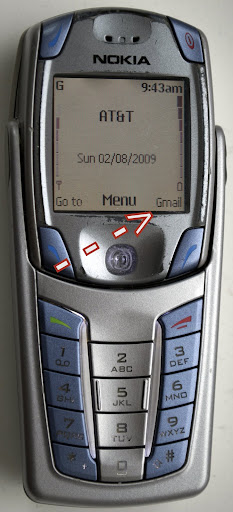
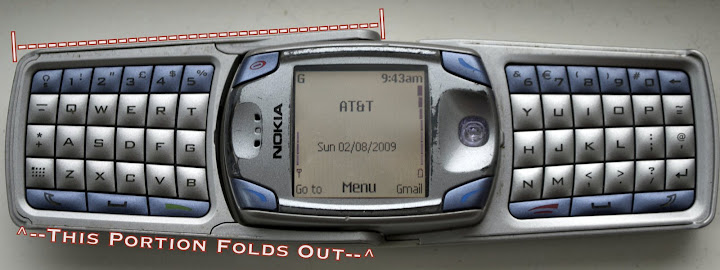
Needless to say, I have been overjoyed since getting this phone working again and have been (re)familiarizing myself with it's features. I have gone through and added all the voice tags (so when I'm wearing a headset I can say the name without having to dial.) One of the greatest features is the fold out keyboard for text messaging. Though many phones have QWERTY keyboards, many sacrifice the size of the phone for this feature. Additionally, I tweaked the phone so I can get to my Gmail account (which is good for emergencies, but which is not a necessity.)
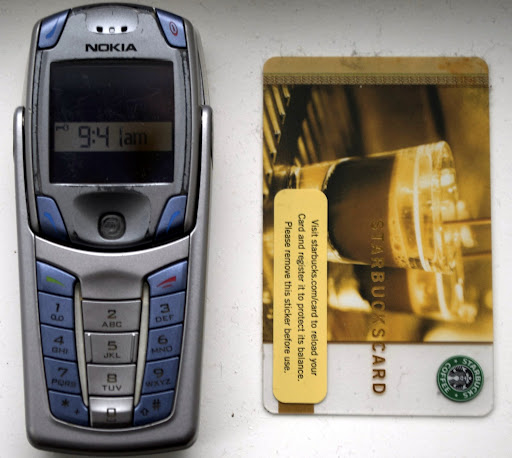
I personally believe this phone is as complicated as a phone should be:
- It has a very basic camera
- The phone is small
- It has voice dialing
- It is Bluetooth capable
- The ringtones are basic and not obnoxious
- Very strong vibration in silent mode
I want to end by mentioning that I do LOVE the iPhone, Blackberry, and other smart phones...but only because they are like toys. I personally don't think it is wise to consolidate all of these things into a single tool. I believe in carrying a toolbox rather than just a Swiss army knife. I have an awesome hand held GPS, two wonderful cameras, a great computer, and an 80gb iPod that's almost full of music. I love having reasons to bring these items (each as needed) on trips and don't mind that they are independent of each other. If one of them breaks, needs new batteries, or just needs to be upgraded I don't have to give them all up to do so.
My cell phone is just one of my tools...not all of them.
Friday, January 30, 2009
Facebook...Social Media...What's Your Take?
 I recently read "You Have No Friends: Everyone else is on Facebook. Why aren't you?" on Slate.com (http://www.slate.com/id/2208678/pagenum/all/#p2) and I was going to write a long drawn out response (I'm not on Facebook.) But instead of dawning my tinfoil hat, I thought I would experiment with a survey.
If you would rather just respond in a comment for the world to see, you can do that too!
 It should probably be noted that at one time I had 2 (two) Myspace accounts at the same time (one was a Tyler Durden-esc alter ego.) After one of the most life changing conversations with my wife (at the time she was my girlfriend) my perspective changed about myspace and social media permanently.
Anyway, what are your thoughts? Let me know!
Lastly for those who aren't sure what social media is here are some examples:
Facebook.com
Twitter.com
Myspace.com
etc
oh...and yes...Blogger is considered social media too!
Thursday, January 01, 2009
I Did This Once And Pat Has Done This HUNDREDS Of Times
The other day I was asked to help the chief engineer at KRCW by accompanying him to a transmitter site out in the mountains of south east of Portland. Pat has either driven, snow catted, snowmobiled, and snowshoed to this transmitter literally hundreds of times. He is one of those guys that 99% of what he does is unseen (and under-appreciated at times.) I made the below video on a whim (20 minutes on iMovie) to "dramatize" my ride up there. Seriously though, it is a LONG haul and driving a snow cat is no easy feat (I tried for 10 minutes.)
A very special thanks to Pat who included me on this job and allowing me to experience something that very few have had the opportunity to experience in person. Pat is a humble guy who will never ever admit to the amount of behind the scenes work he does. He works hard for the sake of keeping your television signal top notch.
(I will try to improve the quality of the you tube video as soon as I figure it out.)
A very special thanks to Pat who included me on this job and allowing me to experience something that very few have had the opportunity to experience in person. Pat is a humble guy who will never ever admit to the amount of behind the scenes work he does. He works hard for the sake of keeping your television signal top notch.
(I will try to improve the quality of the you tube video as soon as I figure it out.)
Monday, December 22, 2008
Internet Job Searches: Half The Time, Twice As Difficult
I have been trying for some time now to find a career with a little more meaning. I have been looking online throughout the Northwest (I define the Northwest as Washington, Idaho, Oregon, Montana, Wyoming, parts of Colorado, and Taos, New Mexico.) The search is tedious and frustrating.
 When I was younger, I remember job searching was a 3 step process:
Back then it was a very simple task and most times I would even have the opportunity to shake hands with a "personnel manager." Sometimes I would get a call back and sometimes I wouldn't. Every week a new job listing would come out in the local paper and the process would begin all over again.
When the internet hit the mainstream I thought that hiring would become this simple process, and that unemployment would be left to those who just didn't want to work. In the early 2000s, I put my resume online expecting Donald Trump and Bill Gates to get into a bidding war over who could have me. Surprisingly, nothing happened and I ended up getting a great job from an inside recommendation.

Today, job hunting can appear to be pretty daunting. Walk near a business section of a bookstore and you will see an entire aisle dedicated to resume writing, interviewing, and job hunting. I know people who are too scared to leave their jobs to find a better one, just because they feel like they don't know how to do a 21st century job search.
Job hunting via the internet requires a little bit of knowledge and plenty of patience. First, one must know WHICH job search engines to use. Years ago it was Monster, Hotjobs, etc. Today web 2.0 has made things much easier.
Here are my favorites:
The options to get your resume to the employer can be varied. Some employers want you to email a cover letter and resume, while others have a custom interface that allows you to cut and paste your cover letter and resume (goodbye hours of formatting.) Other employers have online applications that require you to nearly rewrite your entire resume.
 After you submit the required materials you have to wait. Most sites say "no phone calls" so you can't call to see if they received your resume and cover letter. I find myself checking their employment page hoping that I get an email or a phone call before the posting disappears. On a daily basis I repeat this process...it can be pretty depressing.
I might add that November and December have been challenging months to find a job. I refuse to blindly blame the economy...instead I point the finger at the Thanksgiving and winter holidays. This time of year there are more people on vacation, more office functions, and a desire to postpone projects to 2009. I have high hopes for January!
When I was younger, I remember job searching was a 3 step process:- Find open positions in the newspaper
- Go to the hiring business and ask for an application
- Fill out application (bonus for typing) and return to potential employer
Back then it was a very simple task and most times I would even have the opportunity to shake hands with a "personnel manager." Sometimes I would get a call back and sometimes I wouldn't. Every week a new job listing would come out in the local paper and the process would begin all over again.
When the internet hit the mainstream I thought that hiring would become this simple process, and that unemployment would be left to those who just didn't want to work. In the early 2000s, I put my resume online expecting Donald Trump and Bill Gates to get into a bidding war over who could have me. Surprisingly, nothing happened and I ended up getting a great job from an inside recommendation.
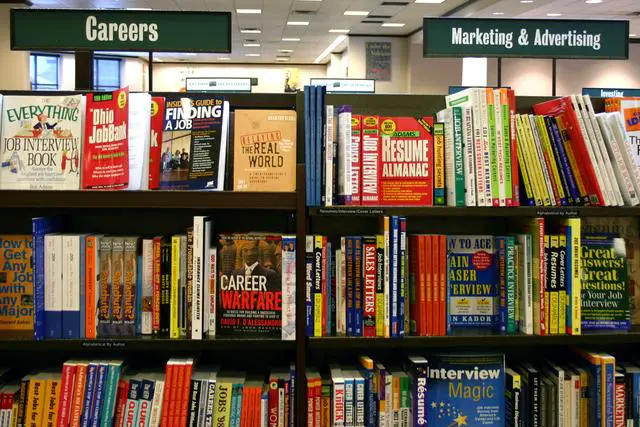
Today, job hunting can appear to be pretty daunting. Walk near a business section of a bookstore and you will see an entire aisle dedicated to resume writing, interviewing, and job hunting. I know people who are too scared to leave their jobs to find a better one, just because they feel like they don't know how to do a 21st century job search.
Job hunting via the internet requires a little bit of knowledge and plenty of patience. First, one must know WHICH job search engines to use. Years ago it was Monster, Hotjobs, etc. Today web 2.0 has made things much easier.
Here are my favorites:
- Indeed.com
- Simplyhired.com
- craigslist.org (I recommend using crazedlist.org - it searches multiple craigslist sites at the same time)
The options to get your resume to the employer can be varied. Some employers want you to email a cover letter and resume, while others have a custom interface that allows you to cut and paste your cover letter and resume (goodbye hours of formatting.) Other employers have online applications that require you to nearly rewrite your entire resume.
 After you submit the required materials you have to wait. Most sites say "no phone calls" so you can't call to see if they received your resume and cover letter. I find myself checking their employment page hoping that I get an email or a phone call before the posting disappears. On a daily basis I repeat this process...it can be pretty depressing.
I might add that November and December have been challenging months to find a job. I refuse to blindly blame the economy...instead I point the finger at the Thanksgiving and winter holidays. This time of year there are more people on vacation, more office functions, and a desire to postpone projects to 2009. I have high hopes for January!
Tuesday, December 09, 2008
Stress, Traffic Jams, And Shopping Lists
I was emailed the below video a couple of days ago and it affects me every time I watch it. Though the message is Christian based, the concept is one that everybody can grasp.
Last year (around this time) we learned about how much money is spent "around" (double meaning) Christmas and how little of it actually trickles down to those who need it. Of course water is one example as cited in this video, but you could easily find somebody in your own neighborhood that could use help (time, money, friendship, etc.)
I post this video for those who feel like something has been missing during Christmas (and a couple of examples of what they could do.)
Last year (around this time) we learned about how much money is spent "around" (double meaning) Christmas and how little of it actually trickles down to those who need it. Of course water is one example as cited in this video, but you could easily find somebody in your own neighborhood that could use help (time, money, friendship, etc.)
I post this video for those who feel like something has been missing during Christmas (and a couple of examples of what they could do.)
Thursday, December 04, 2008
An Anthropological Introduction To YouTube
My wife and I found this to be extremely captivating (but beware...it's almost an hour long.) I believe that this is one of the most important videos of 2008 (and it's not even about global warming climate change!)
Special thanks to Peter for sharing this with me!
Your insights welcome . . .
Special thanks to Peter for sharing this with me!
Your insights welcome . . .
Wednesday, December 03, 2008
Fitness Gadget For Desk Jockies (Or How To Get More Activity Back In Your Day)
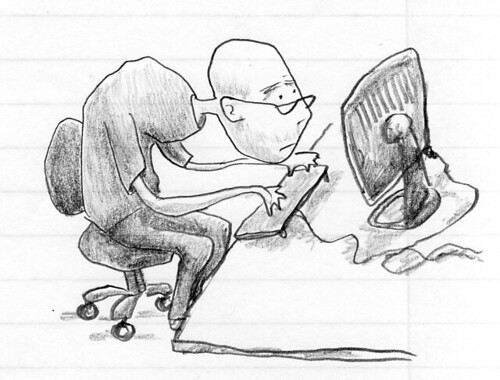 I used to spend my entire day at a desk (yes...there was ping pong...thank goodness.) My problem was that I never got enough exercise during the work week. My commute was almost an hour each way and by the time I got home I was in no mood to go to the gym. I tried some of the old tricks such as moving my printer out of my office (which did help) and I tried to get out of my chair and meeting people face to face (instead of calling or emailing someone who was just down the hall.) I am no longer working there yet I have to be on top of my activity level and monitor it so I don't go the way of the couch potato.
Sometime last year I became fascinated with the concept of the pedometer. Previously I thought of a pedometer as one of those devices that someone buys in hopes to see how FAR they walk. My mother even had one years ago and we all agreed it was truly inconvenient. Back then you had to wear it on your waist, it looked like a garage door opener, and it never really did the job in a useful manner (it was just easier to drive in a car to calculate how far you walked.)
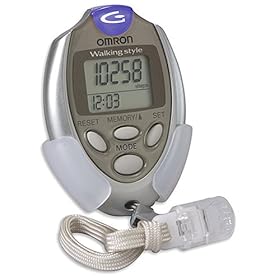 So sometime at the beginning of 2008 I did some new research to see if pedometers had improved. Much to my surprise, pedometers had come a long way. In my research I found one in particular that seemed to be a favorite: the Omron HJ-112 Digital Premium Pedometer.
This pedometer has an amazing 1,933 customer reviews (at the time of this post) on Amazon and has a score of 4.5 out of 5 stars. I decided to order two of these (one for me, one for my wife) and see if I could use it as an "activity motivator."
The device has some really cool (and critical) features:
- Seven day memory
- Tracks: [STEPS, AEROBIC STEPS, KCAL, AND MILES]
- Can be carried anywhere on the body (including a purse)
- Resets itself at midnight (and sends your work to the memory)
After only a week of putting this thing in my pocket as I dressed everyday I realized that the "Steps" category for all practical purposes SHOULD be used ONLY as an index. Like television ratings are to programs, broadcast executives care more about how ratings are up and down, not necessarily what the number indicates (and I might add that very few people actually know what a rating point is.) The "Steps" you take in one day is completely relative to the day before (and the day following.) If you are only starting with 1000 steps on your first day then you walk 2000 steps on your second day, you have DOUBLED your activity level (better than doing nothing.) We can't all walk 10,000 steps in a day (as recommended by sources on the web) the very first day or even a year later for that matter. But you can walk more than you did the day before and that is progress.
I created this chart quickly in Excel.
(Important note: I JUST started using my pedometer again on the 26th of November...it had been in storage for several months before so this is "out of the gate" data)

What is important to note is that my activity level went UP when I started putting it in my pocket again (Sunday was a very lazy day and Monday we were in the car delivering meals to home bound folks.) Today (which is not listed because it ends at midnight) I looked at my 7 day history and decided to try to beat yesterday's steps (6247) and ended up RUNNING a couple of miles which I haven't done for MONTHS (btw the pedometer works just fine if you run with it too.)
In summary, I want to push all of you out there who know that they are having a hard time getting to the gym and want to move in a positive direction. I believe if you use this on a daily basis, you will become more active and those other goals such as losing weight, running more, going to the gym more will follow. This device is the first step in getting you out of the "desk rut" that you may be in.
Where to order: http://www.amazon.com/Omron-HJ-112-Digital-Premium-Pedometer/dp/B0000U1OCI
It's the perfect gadget for a New Year's Resolution . . .
Tuesday, December 02, 2008
Off The Radar Until Next Year
(Please Note...I had been working on a huge blog about cell phones and how the wireless industry has steered so far away from functionality to "gadgetality." If you would like me to post it, please let me know...otherwise I will file it away.)
I've read time and time again that I should update this blog more often if I want to maintain interest. Because a lot of other things are going on in our lives currently I have put the writing to a lower priority. Expect to see something around the first of the year.
In the meantime I have been trying to catch up on my reading. I have been reading 6 books below at the same time and all of them are very interesting!
(all reviews below taken from the web):
 Term Limits - Vince Flynn (Fiction)
In a night of shattering brutality, three of Washington's most powerful and unscrupulous politicians have been executed with surgical precision. Their assassins, vanishing without a trace, have delivered a shocking ultimatum to the leaders of the American government: set aside petty, partisan politics and restore power to the people, or be held to deadly account. No one, they warn, is out of their reach -- not even the president. A joint FBI-CIA task force reveals that the killers are elite military commandos, but no one knows exactly who they are or when they will strike next. Only Michael O'Rourke, a former U.S. Marine and freshman congressman, holds a clue to the violence: a haunting incident in his own past with explosive implications for his country's future.... In a tour de force of action and suspense, Vince Flynn takes the ultimate American ideal -- a government of the people -- to a devastating extreme.
 Creating A World Without Poverty: Social Business And The Future Of Capitalism - Muhammad Yunnus (Non-Fiction)
The winner of the 2006 Nobel Peace Prize outlines his vision for a new business model that combines the power of free markets with the quest for a more humane world - and tells the inspiring stories of companies that are doing this work today. Over the last two decades, free markets have swept the globe, bringing with them enormous potential for positive change. But traditional capitalism cannot solve problems like inequality and poverty, because it is hampered by a narrow view of human nature in which people are one-dimensional beings concerned only with profit. In fact, human beings have many other drives and passions, including the spiritual, the social and the altruistic. Welcome to the world of social business, where the creative vision of the entrepreneur is applied to today's most serious problems: feeding the poor, housing the homeless, healing the sick and protecting the planet. Creating a World Without Poverty tells the stories of some of the earliest examples of social business, including Yunus's own Grameen Bank. It reveals the next phase in a hopeful economic and social revolution that is already under way - and in the worldwide effort to eliminate poverty by unleashing the productive energy of every human being.
 Getting Things Done: The Art Of Stress-Free Productivity - David Allen (Non-Fiction)
In today's world, yesterday's methods just don't work. Veteran coach and management consultant Allen shares the breakthrough methods for stress-free performance that he has introduced to thousands. He shows how to assess goals, relax, and stay focused.
 The Laws Of Simplicity: Design, Technology, Business, Life - John Maeda (Non-Fiction)
Finally, we are learning that simplicity equals sanity. We're rebelling against technology that's too complicated, DVD players with too many menus, and software accompanied by 75-megabyte "read me" manuals. The iPod's clean gadgetry has made simplicity hip. But sometimes we find ourselves caught up in the simplicity paradox: we want something that's simple and easy to use, but also does all the complex things we might ever want it to do. In The Laws of Simplicity, John Maeda offers ten laws for balancing simplicity and complexity in business, technology, and design—guidelines for needing less and actually getting more. Maeda—a professor in MIT's Media Lab and a world-renowned graphic designer—explores the question of how we can redefine the notion of "improved" so that it doesn't always mean something more, something added on. Maeda's first law of simplicity is "Reduce." It's not necessarily beneficial to add technology features just because we can. And the features that we do have must be organized (Law 2) in a sensible hierarchy so users aren't distracted by features and functions they don't need. But simplicity is not less just for the sake of less. Skip ahead to Law 9: "Failure: Accept the fact that some things can never be made simple." Maeda's concise guide to simplicity in the digital age shows us how this idea can be a cornerstone of organizations and their products—how it can drive both business and technology. We can learn to simplify without sacrificing comfort and meaning, and we can achieve the balance described in Law 10. This law, which Maeda calls "The One," tells us: "Simplicity is about subtracting the obvious, and adding the meaningful."
 Dune - Frank Herbert (Fiction)
Here is the novel that will be forever considered a triumph of the imagination. Set on the desert planet Arrakis, DUNE is the story of the boy Paul Atreides, who would become the mysterious man known as Muad’Dib. He would avenge the traitorous plot against his noble family—and would bring to fruition humankind’s most ancient and unattainable dream. A stunning blend of adventure and mysticism, environmentalism and politics, DUNE formed the basis of what is undoubtedly the grandest epic in science fiction.
 Outliers: The Story Of Success - Malcolm Gladwell (Non-Fiction)
Amazon Best of the Month, November 2008: Now that he's gotten us talking about the viral life of ideas and the power of gut reactions, Malcolm Gladwell poses a more provocative question in Outliers: why do some people succeed, living remarkably productive and impactful lives, while so many more never reach their potential? Challenging our cherished belief of the "self-made man," he makes the democratic assertion that superstars don't arise out of nowhere, propelled by genius and talent: "they are invariably the beneficiaries of hidden advantages and extraordinary opportunities and cultural legacies that allow them to learn and work hard and make sense of the world in ways others cannot." Examining the lives of outliers from Mozart to Bill Gates, he builds a convincing case for how successful people rise on a tide of advantages, "some deserved, some not, some earned, some just plain lucky." Outliers can be enjoyed for its bits of trivia, like why most pro hockey players were born in January, how many hours of practice it takes to master a skill, why the descendants of Jewish immigrant garment workers became the most powerful lawyers in New York, how a pilots' culture impacts their crash record, how a centuries-old culture of rice farming helps Asian kids master math. But there's more to it than that. Throughout all of these examples--and in more that delve into the social benefits of lighter skin color, and the reasons for school achievement gaps--Gladwell invites conversations about the complex ways privilege manifests in our culture. He leaves us pondering the gifts of our own history, and how the world could benefit if more of our kids were granted the opportunities to fulfill their remarkable potential.
Here is my progress on reading all of these as of 10:18am on December 2, 2008:

I've read time and time again that I should update this blog more often if I want to maintain interest. Because a lot of other things are going on in our lives currently I have put the writing to a lower priority. Expect to see something around the first of the year.
In the meantime I have been trying to catch up on my reading. I have been reading 6 books below at the same time and all of them are very interesting!
(all reviews below taken from the web):
Term Limits - Vince Flynn (Fiction)In a night of shattering brutality, three of Washington's most powerful and unscrupulous politicians have been executed with surgical precision. Their assassins, vanishing without a trace, have delivered a shocking ultimatum to the leaders of the American government: set aside petty, partisan politics and restore power to the people, or be held to deadly account. No one, they warn, is out of their reach -- not even the president. A joint FBI-CIA task force reveals that the killers are elite military commandos, but no one knows exactly who they are or when they will strike next. Only Michael O'Rourke, a former U.S. Marine and freshman congressman, holds a clue to the violence: a haunting incident in his own past with explosive implications for his country's future.... In a tour de force of action and suspense, Vince Flynn takes the ultimate American ideal -- a government of the people -- to a devastating extreme.
Creating A World Without Poverty: Social Business And The Future Of Capitalism - Muhammad Yunnus (Non-Fiction)The winner of the 2006 Nobel Peace Prize outlines his vision for a new business model that combines the power of free markets with the quest for a more humane world - and tells the inspiring stories of companies that are doing this work today. Over the last two decades, free markets have swept the globe, bringing with them enormous potential for positive change. But traditional capitalism cannot solve problems like inequality and poverty, because it is hampered by a narrow view of human nature in which people are one-dimensional beings concerned only with profit. In fact, human beings have many other drives and passions, including the spiritual, the social and the altruistic. Welcome to the world of social business, where the creative vision of the entrepreneur is applied to today's most serious problems: feeding the poor, housing the homeless, healing the sick and protecting the planet. Creating a World Without Poverty tells the stories of some of the earliest examples of social business, including Yunus's own Grameen Bank. It reveals the next phase in a hopeful economic and social revolution that is already under way - and in the worldwide effort to eliminate poverty by unleashing the productive energy of every human being.
Getting Things Done: The Art Of Stress-Free Productivity - David Allen (Non-Fiction)In today's world, yesterday's methods just don't work. Veteran coach and management consultant Allen shares the breakthrough methods for stress-free performance that he has introduced to thousands. He shows how to assess goals, relax, and stay focused.
The Laws Of Simplicity: Design, Technology, Business, Life - John Maeda (Non-Fiction)Finally, we are learning that simplicity equals sanity. We're rebelling against technology that's too complicated, DVD players with too many menus, and software accompanied by 75-megabyte "read me" manuals. The iPod's clean gadgetry has made simplicity hip. But sometimes we find ourselves caught up in the simplicity paradox: we want something that's simple and easy to use, but also does all the complex things we might ever want it to do. In The Laws of Simplicity, John Maeda offers ten laws for balancing simplicity and complexity in business, technology, and design—guidelines for needing less and actually getting more. Maeda—a professor in MIT's Media Lab and a world-renowned graphic designer—explores the question of how we can redefine the notion of "improved" so that it doesn't always mean something more, something added on. Maeda's first law of simplicity is "Reduce." It's not necessarily beneficial to add technology features just because we can. And the features that we do have must be organized (Law 2) in a sensible hierarchy so users aren't distracted by features and functions they don't need. But simplicity is not less just for the sake of less. Skip ahead to Law 9: "Failure: Accept the fact that some things can never be made simple." Maeda's concise guide to simplicity in the digital age shows us how this idea can be a cornerstone of organizations and their products—how it can drive both business and technology. We can learn to simplify without sacrificing comfort and meaning, and we can achieve the balance described in Law 10. This law, which Maeda calls "The One," tells us: "Simplicity is about subtracting the obvious, and adding the meaningful."
 Dune - Frank Herbert (Fiction)
Here is the novel that will be forever considered a triumph of the imagination. Set on the desert planet Arrakis, DUNE is the story of the boy Paul Atreides, who would become the mysterious man known as Muad’Dib. He would avenge the traitorous plot against his noble family—and would bring to fruition humankind’s most ancient and unattainable dream. A stunning blend of adventure and mysticism, environmentalism and politics, DUNE formed the basis of what is undoubtedly the grandest epic in science fiction.
 Outliers: The Story Of Success - Malcolm Gladwell (Non-Fiction)
Amazon Best of the Month, November 2008: Now that he's gotten us talking about the viral life of ideas and the power of gut reactions, Malcolm Gladwell poses a more provocative question in Outliers: why do some people succeed, living remarkably productive and impactful lives, while so many more never reach their potential? Challenging our cherished belief of the "self-made man," he makes the democratic assertion that superstars don't arise out of nowhere, propelled by genius and talent: "they are invariably the beneficiaries of hidden advantages and extraordinary opportunities and cultural legacies that allow them to learn and work hard and make sense of the world in ways others cannot." Examining the lives of outliers from Mozart to Bill Gates, he builds a convincing case for how successful people rise on a tide of advantages, "some deserved, some not, some earned, some just plain lucky." Outliers can be enjoyed for its bits of trivia, like why most pro hockey players were born in January, how many hours of practice it takes to master a skill, why the descendants of Jewish immigrant garment workers became the most powerful lawyers in New York, how a pilots' culture impacts their crash record, how a centuries-old culture of rice farming helps Asian kids master math. But there's more to it than that. Throughout all of these examples--and in more that delve into the social benefits of lighter skin color, and the reasons for school achievement gaps--Gladwell invites conversations about the complex ways privilege manifests in our culture. He leaves us pondering the gifts of our own history, and how the world could benefit if more of our kids were granted the opportunities to fulfill their remarkable potential.
Here is my progress on reading all of these as of 10:18am on December 2, 2008:

Subscribe to:
Posts (Atom)