There are earlier versions of this that aren't as snappy (see here: http://www.youtube.com/watch?v=pMcfrLYDm2U) as this one, but the message is somewhat the same. A while ago I started another blog Geolibrium.blogspot.com (Geo=Earth Librium=Balance) as a way to share interesting (and sometimes boring) tidbits on our earth (namely geopolitics) and how they are rapidly shaping our future. Check it out when you have the chance!
Hope this video makes you think!
Sunday, March 29, 2009


Wednesday, March 04, 2009
Why TV Lost
I read the below essay late last night and it really affected me. I worked in television up until recently for just over nine years. From my first day of work I knew that television wouldn't be around forever. My poor co-workers had to put up with me saying "the end is near!" The below essay captures what I couldn't say.
Source: http://paulgraham.com/convergence.html
When I woke up this morning the following entered my mind.
The reason [INSERT NEWSPAPER, RADIO, TELEVISION, INTERNET, OR "NEXT GADGET" HERE] is successful is because of the following factors:
Why TV Lost
March 2009About twenty years ago people noticed computers and TV were on a collision course and started to speculate about what they'd produce when they converged. We now know the answer: computers. It's clear now that even by using the word "convergence" we were giving TV too much credit. This won't be convergence so much as replacement. People may still watch things they call "TV shows," but they'll watch them mostly on computers.
What decided the contest for computers? Four forces, three of which one could have predicted, and one that would have been harder to.
One predictable cause of victory is that the Internet is an open platform. Anyone can build whatever they want on it, and the market picks the winners. So innovation happens at hacker speeds instead of big company speeds.
The second is Moore's Law, which has worked its usual magic on Internet bandwidth. [1]
The third reason computers won is piracy. Users prefer it not just because it's free, but because it's more convenient. Bittorrent and YouTube have already trained a new generation of viewers that the place to watch shows is on a computer screen. [2]
The somewhat more surprising force was one specific type of innovation: social applications. The average teenage kid has a pretty much infinite capacity for talking to their friends. But they can't physically be with them all the time. When I was in high school the solution was the telephone. Now it's social networks, multiplayer games, and various messaging applications. The way you reach them all is through a computer. [3] Which means every teenage kid (a) wants a computer with an Internet connection, (b) has an incentive to figure out how to use it, and (c) spends countless hours in front of it.
This was the most powerful force of all. This was what made everyone want computers. Nerds got computers because they liked them. Then gamers got them to play games on. But it was connecting to other people that got everyone else: that's what made even grandmas and 14 year old girls want computers.
After decades of running an IV drip right into their audience, people in the entertainment business had understandably come to think of them as rather passive. They thought they'd be able to dictate the way shows reached audiences. But they underestimated the force of their desire to connect with one another.Facebook killed TV. That is wildly oversimplified, of course, but probably as close to the truth as you can get in three words.
___
The TV networks already seem, grudgingly, to see where things are going, and have responded by putting their stuff, grudgingly, online. But they're still dragging their heels. They still seem to wish people would watch shows on TV instead, just as newspapers that put their stories online still seem to wish people would wait till the next morning and read them printed on paper. They should both just face the fact that the Internet is the primary medium.
They'd be in a better position if they'd done that earlier. When a new medium arises that's powerful enough to make incumbents nervous, then it's probably powerful enough to win, and the best thing they can do is jump in immediately.
Whether they like it or not, big changes are coming, because the Internet dissolves the two cornerstones of broadcast media: synchronicity and locality. On the Internet, you don't have to send everyone the same signal, and you don't have to send it to them from a local source. People will watch what they want when they want it, and group themselves according to whatever shared interest they feel most strongly. Maybe their strongest shared interest will be their physical location, but I'm guessing not. Which means local TV is probably dead. It was an artifact of limitations imposed by old technology. If someone were creating an Internet-based TV company from scratch now, they might have some plan for shows aimed at specific regions, but it wouldn't be a top priority.
Synchronicity and locality are tied together. TV network affiliates care what's on at 10 because that delivers viewers for local news at 11. This connection adds more brittleness than strength, however: people don't watch what's on at 10 because they want to watch the news afterward.
TV networks will fight these trends, because they don't have sufficient flexibility to adapt to them. They're hemmed in by local affiliates in much the same way car companies are hemmed in by dealers and unions. Inevitably, the people running the networks will take the easy route and try to keep the old model running for a couple more years, just as the record labels have done.
A recent article in the Wall Street Journal described how TV networks were trying to add more live shows, partly as a way to make viewers watch TV synchronously instead of watching recorded shows when it suited them. Instead of delivering what viewers want, they're trying to force them to change their habits to suit the networks' obsolete business model. That never works unless you have a monopoly or cartel to enforce it, and even then it only works temporarily.
The other reason networks like live shows is that they're cheaper to produce. There they have the right idea, but they haven't followed it to its conclusion. Live content can be way cheaper than networks realize, and the way to take advantage of dramatic decreases in cost is to increase volume. The networks are prevented from seeing this whole line of reasoning because they still think of themselves as being in the broadcast business—as sending one signal to everyone. [4]
- - -
Now would be a good time to start any company that competes with TV networks. That's what a lot of Internet startups are, though they may not have had this as an explicit goal. People only have so many leisure hours a day, and TV is premised on such long sessions (unlike Google, which prides itself on sending users on their way quickly) that anything that takes up their time is competing with it. But in addition to such indirect competitors, I think TV companies will increasingly face direct ones.
(Click for larger image)
Even in cable TV, the long tail was lopped off prematurely by the threshold you had to get over to start a new channel. It will be longer on the Internet, and there will be more mobility within it. In this new world, the existing players will only have the advantages any big company has in its market.
That will change the balance of power between the networks and the people who produce shows. The networks used to be gatekeepers. They distributed your work, and sold advertising on it. Now the people who produce a show can distribute it themselves. The main value networks supply now is ad sales. Which will tend to put them in the position of service providers rather than publishers.
Shows will change even more. On the Internet there's no reason to keep their current format, or even the fact that they have a single format. Indeed, the more interesting sort of convergence that's coming is between shows and games. But on the question of what sort of entertainment gets distributed on the Internet in 20 years, I wouldn't dare to make any predictions, except that things will change a lot. We'll get whatever the most imaginative people can cook up. That's why the Internet won.
Notes
1. Thanks to Trevor Blackwell for this point. He adds: "I remember the eyes of phone companies gleaming in the early 90s when they talked about convergence. They thought most programming would be on demand, and they would implement it and make a lot of money. It didn't work out. They assumed that their local network infrastructure would be critical to do video on-demand, because you couldn't possibly stream it from a few data centers over the internet. At the time (1992) the entire cross-country Internet bandwidth wasn't enough for one video stream. But wide-area bandwidth increased more than they expected and they were beaten by iTunes and Hulu."
2. Copyright owners tend to focus on the aspect they see of piracy, which is the lost revenue. They therefore think what drives users to do it is the desire to get something for free. But iTunes shows that people will pay for stuff online, if you make it easy. A significant component of piracy is simply that it offers a better user experience.
3. Or a phone that is actually a computer. I'm not making any predictions about the size of the device that will replace TV, just that it will have a browser and get data via the Internet.
4. Emmett Shear writes: "I'd argue the long tail for sports may be even larger than the long tail for other kinds of content. Anyone can broadcast a high school football game that will be interesting to 10,000 people or so, even if the quality of production is not so good."
Thanks to Sam Altman, Trevor Blackwell, Nancy Cook, Michael Seibel. Emmett Shear, and Fred Wilson for reading drafts of this.

Source: http://paulgraham.com/convergence.html
When I woke up this morning the following entered my mind.
The reason [INSERT NEWSPAPER, RADIO, TELEVISION, INTERNET, OR "NEXT GADGET" HERE] is successful is because of the following factors:
- We will want to use it all the time.
- We will talk about it when we aren't using it.
- We will go to great lengths to teach or convince others to use it.
Sunday, February 08, 2009
My iPhone Killer...
 For a long time I've been wanting to write more in the theme of why I created this blog in the first place...keeping things simple. The definition of simplicity is "the property, condition, or quality of being simple or uncombined."
In the electronics world, more and more it's about features, buttons, and menus that help sell the product. While I am a gadget lover and guilty of buying the most pointless and complex digital toys, there is one device that I believe has fallen off course from it's original purpose...the cell phone.
 I bought my first cell phone in 1996. I was in the Marine Corps and had no means of communication other than payphones (remember them?) The phone was as big as a pack of cigarettes and had limited talk time. Also the rate plans back then were all by individual minutes (no 500 minute plans or whatnot.) I tried to use my phone only when needed and managed to keep costs low.
In the late 90s cell phones became more common and pricing plans were more affordable. In 1999, I signed up with AT&T Wireless and bought my first Nokia phone. This phone I used a little more because I was rarely home (work, college, etc.) Needless to say I found myself upgrading my phone every 2 years...but why? The truth is that I was in love with the gadgetness.
 Enter 2009... The iPhone has been out for a couple of years and other cell phones (and "smart" phones) have made leaps and bounds in technology...but to what benefit? Isn't a phone for communicating with people in real time? How did the MP3 player, GPS, camera, internet browser, and video player become essential tools? I will agree that email on the phone in today's day and age is very important for people in certain professions. I also will concede that text messaging is a wonderful thing. What frustrates me is that it is very hard to find a simple phone minus the crap.
 As I mentioned I used to buy a new phone every so often. One phone in particular that I purchased in 2004 was the Nokia 6820b (pictured right.) I cherished this simple phone up until AT&T became Cingular. The folks at the Cingular store said that it will not work on their network and I had to get a new phone. At the time I thought that it was just a matter of time before Nokia (and Cingular) would introduce the next version of this phone. Unfortunately...it never happened. Instead Cingular became AT&T again and the iPhone and Blackberry became the weapon of choice for gadget lovers like me.
 I have ooohed and aaahed over the iPhone and the various Blackberry phones. I even had a Blackberry Curve for a week until I realized that I was wasting time (and an extra $30 a month) on this gadget. It was constantly demanding my attention. *BEEP*....'oh, a new email'....*BEEP*....'something from my work email'....*BEEP*....'oh someone just commented on my blog'. . .you get the idea. I returned it and begged them for something simple. I ended up taking the free basic Nokia phone.
About a month ago I was digging through some old electronic stuff and found my old Nokia 6820b. I thought since AT&T was now back that I would stick my SIM card in this antiquated phone and see if it worked. The phone display read ENTER UNLOCK CODE. I immediately went to the web and frantically tried to find some magical code that would make this phone work. After going to many geek sites with various codes (that did not work) I gave up. Just the other day I had some time to kill in downtown Portland and decided to see if I could find anyone who could help me get this phone to work again.
The first place I went was the AT&T Wireless store. I showed them my phone and described my frustration with the phones that they sell now. The salesperson went around and showed me all of the basic phones, which were a little too basic (not to mention I would have to restart my contract with them...which I am thankfully no longer in.) The salesperson said he did know someone in town that might be able to get it to work again. He handed me his card and I hopped on the MAX headed over the river.
After a short walk from the Hollywood MAX station I arrived at AIRLINK. (Located at 3626 NE Sandy Blvd, Portland, OR 97232) I tried not to get my hopes up when I showed the salesperson my phone and asked if he could get it to work. Without even blinking, he looked at me and said "no problem!" In less then 10 minutes and for a couple of bucks, my beloved phone from the past was working on the AT&T network.
View Larger Map
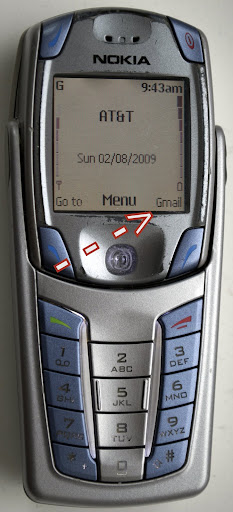
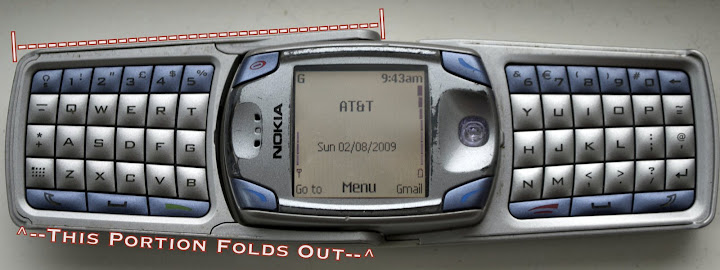
Needless to say, I have been overjoyed since getting this phone working again and have been (re)familiarizing myself with it's features. I have gone through and added all the voice tags (so when I'm wearing a headset I can say the name without having to dial.) One of the greatest features is the fold out keyboard for text messaging. Though many phones have QWERTY keyboards, many sacrifice the size of the phone for this feature. Additionally, I tweaked the phone so I can get to my Gmail account (which is good for emergencies, but which is not a necessity.)
I personally believe this phone is as complicated as a phone should be:
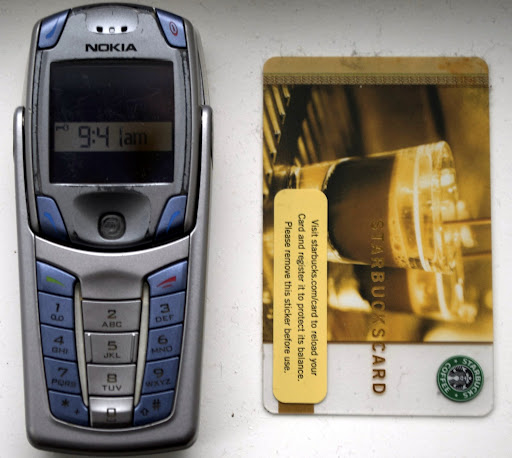
- It has a very basic camera
- The phone is small
- It has voice dialing
- It is Bluetooth capable
- The ringtones are basic and not obnoxious
- Very strong vibration in silent mode
I want to end by mentioning that I do LOVE the iPhone, Blackberry, and other smart phones...but only because they are like toys. I personally don't think it is wise to consolidate all of these things into a single tool. I believe in carrying a toolbox rather than just a Swiss army knife. I have an awesome hand held GPS, two wonderful cameras, a great computer, and an 80gb iPod that's almost full of music. I love having reasons to bring these items (each as needed) on trips and don't mind that they are independent of each other. If one of them breaks, needs new batteries, or just needs to be upgraded I don't have to give them all up to do so.
My cell phone is just one of my tools...not all of them.
Subscribe to:
Posts (Atom)